









Is Pepperstone an ECN Broker or Market Maker?
The question of whether a forex/CFD broker operates as an ECN or a Market Maker is fundamental for any serious trader. This distinction defines how your trades are executed, how prices are quoted, and whether the broker might have any potential conflict of interest with its clients. When it comes to a highly regarded, award-winning broker like Pepperstone, understanding its model is crucial for making an informed trading decision.
So, is Pepperstone an ECN broker or a Market Maker? In this article, we’ll explore Pepperstone’s execution model, the key differences between ECN and Market Maker systems, and what this means for you as a trader.
Understanding ECN vs Market Maker Models
Before analysing Pepperstone’s operations, it’s important to understand what distinguishes an ECN broker from a Market Maker. An ECN broker operates as a true intermediary. It connects traders directly to a pool of liquidity providers, such as banks, hedge funds, and other market participants, who quote real-time bid and ask prices.
In this model, orders are matched electronically with the best available prices in the network. Traders can usually expect variable spreads, reflecting real market conditions. The broker earns a commission per trade, rather than making money from client losses. This setup ensures no dealing desk intervention and minimal conflict of interest. However, because ECN brokers pass orders directly to the market, traders might experience occasional slippage, especially during volatile market conditions.
A Market Maker, by contrast, provides liquidity internally by setting its own bid and ask prices. When you trade with a Market Maker, the broker itself is the counterparty to your trade. This means that your loss is often the broker’s gain, and vice versa. Usually, market maker brokers can manage to keep spreads fixed, but they are typically wider than the market spreads. While this model can provide stable pricing and guaranteed liquidity, it also creates a potential conflict of interest between the broker and the trader.
What we have explained above is the fundamental difference between the two major execution philosophies. But the reality in modern operations is that brokers often blend elements of both. Both models offer pros and cons that traders must weigh. So, is Pepperstone an ECN or a Market Maker? Let’s explore.
Pepperstone’s Execution Model
Pepperstone has built its global reputation as an ECN and No-Dealing-Desk (NDD) broker. The company does not act as a Market Maker and does not take the opposite side of client trades. Instead, Pepperstone aggregates liquidity from multiple top-tier liquidity providers, including tier-1 banks and financial institutions. The broker then passes this pricing to its clients via an electronic communication network, without a dealing desk intervening.

That said, it’s important to note that Pepperstone is the issuer of the products that it provides, and it has control over the systems that it uses. A true ECN or STP broker works as an introducing broker or a broker who operates using someone else’s system under a white label arrangement. Pepperstone improves upon this system by operating its own system and, hence, forming a direct relationship with its clients.
The broker's commitment to the ECN model is evident in its infrastructure. It boasts connections to over 22 liquidity providers, ensuring deep liquidity, competitive pricing, and fast execution speeds that are characteristic of an ECN environment.
However, it's important to understand that all reputable ECN brokers employ sophisticated risk management systems. In certain situations, such as with extremely predictable, low-volume retail client flow, a broker might internalise this flow to provide guaranteed, instant execution.
74.1% of retail CFD accounts lose money
What This Means for Traders
The critical takeaway is that Pepperstone's primary business is to facilitate your trades in the global market, not to trade against you. Your profit is not their loss. This alignment of interests is a cornerstone of their service.
With Pepperstone, traders receive raw spreads directly from liquidity providers. The broker's compensation comes from a clear, upfront commission on the razor account or a small markup on the standard account. Orders are executed at the best available price from the liquidity pool. This means you may experience slippage, both positive (in your favour) and negative, especially during high-volatility news events. This is common among brokers using the ECN model.
In essence, Pepperstone operates a Model that is functionally much closer to an ECN than a Market Maker.
Should You Care Which Model a Broker Uses?
Yes, the execution model of a broker is critically important as it fundamentally affects trade execution quality. However, this should not be considered in isolation. Instead of obsessing over the label, traders should focus on the measurable outcomes that the model produces. Pepperstone's ECN model delivers on key performance metrics.
For starters, Pepperstone consistently ranks among the fastest brokers. With the Pepperstone Group Limited branch, most orders are executed in under 30 milliseconds, while with Pepperstone Limited, execution times are typically under 60 milliseconds. Additionally, Pepperstone boasts a fill rate of 99.59%, outperforming many of its peers.
So while labels like ECN or STP are informative, the real evidence lies in trading performance. Pepperstone delivers well in that regard.
Pepperstone Markets, Accounts, and Trading Platforms
Pepperstone is a highly regarded name in the global trading industry. It offers a wide range of over 1,400 market products, allowing traders to diversify their portfolios. Specifically, clients can access CFDs on forex, indices, commodities, currency indices, cryptocurrencies, stocks, and ETFs. Traders can choose from several platforms, including MetaTrader 4, MetaTrader 5, cTrader, TradingView, and its proprietary Pepperstone Trading Platform.
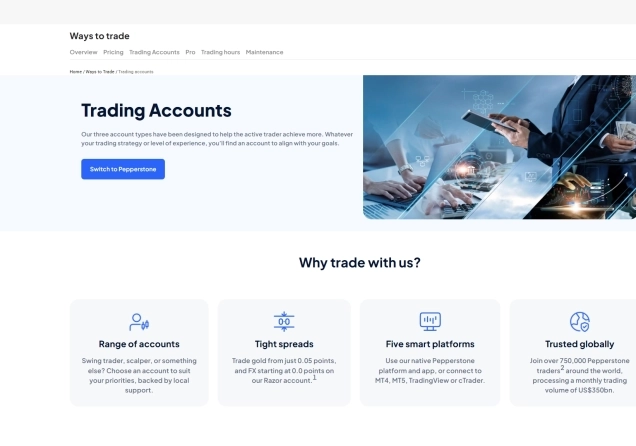
On trading costs, Pepperstone keeps things competitive with clear, low-cost pricing. The Standard Account features spreads starting from 1.0 pips with no commission charges. Meanwhile, the Razor Account offers raw spreads from 0.0 pips and a small commission, which varies depending on the trading platform.

For users trading via MT4 or MT5, the commission is set at $3.50, €2.60, £2.25, or CHF 3.30 per side per lot, depending on the account currency. The same $3.50 per side per lot applies to those using TradingView or the Pepperstone Trading Platform. However, cTrader users enjoy slightly reduced costs, with a commission of $3.00 per side per lot.
For traders using TradingView, cTrader, or the Pepperstone Trading Platform in a currency other than USD, all commission charges are automatically converted to the account’s base currency at the current spot exchange rate.
Pepperstone also maintains a strong commitment to regulatory compliance. The broker operates under the supervision of multiple financial regulators. These include the FCA in the UK, the CySEC in Cyprus, the ASIC in Australia, the BaFin in Germany, the CMA in Kenya, and the DFSA in Dubai, among others.
Final Comments
So, is Pepperstone an ECN broker or a Market Maker? The definitive answer is that Pepperstone has the closest characteristics to an ECN broker with a No-Dealing-Desk model. It does not act as a Market Maker, does not manipulate prices, and does not take the opposite side of client trades. Instead, Pepperstone routes all orders directly to its deep liquidity providers, ensuring genuine market access, competitive spreads, and transparent pricing.
For traders, this means a fairer, faster, and more professional trading environment. It ensures that your interests are aligned with the broker's profits from your trading volume, not from your losses. While model matters, Pepperstone’s strength lies in tangible results. Its regulated status, competitive pricing, diverse instrument offering, and advanced trading platforms further enhance its appeal as an ECN broker.
74.1% of retail CFD accounts lose money



Top-Tier Trusted Brokers
The table below contains links to 3rd party websites of our top partners from whom we receive compensation at no additional cost to you.