











What are the Most Traded Indices in the World? Analysis
Stock market indices are among the most watched and actively traded financial instruments. They provide a snapshot of market sentiment, economic health, and investment trends across countries and regions.
However, not all indices attract the same level of trading activity. A small group dominates global volume due to their liquidity, economic relevance, and availability. So, what are the most traded indices in the world? In this article, we will examine the most traded indices in the world and explain why they attract such global attention.
Understanding Stock Market Indices
A stock market index is a financial instrument that tracks the performance of a selected group of stocks designed to represent a particular market, economy, or sector. Instead of tracking individual companies, an index aggregates price movements to provide a broader market perspective.
Most major indices are weighted either by market capitalisation or by price weighting. When weighted by market capitalisation, larger companies carry more influence, while when weighted by price, higher-priced stocks have a greater impact regardless of company size. These constructions affect how the index moves and how traders interpret its performance.
Notably, indices can be traded through various instruments, including CFDs, futures contracts, exchange-traded funds (ETFs), and options. Through these products, traders can speculate on index movements without owning the underlying shares. With that said, let’s now take a look at some of the most traded indices in the world.
The Most Traded Indices in the World
The S&P 500 (United States)
The S&P 500 is widely regarded as the most important and most traded stock index globally. It tracks the performance of 500 of the largest publicly listed companies in the United States. The index spans all major sectors, including technology, healthcare, financial services, energy, industrials, and consumer discretionary, making it a comprehensive benchmark for overall market performance.

The S&P 500’s popularity comes from its broad diversification, deep liquidity, and widespread use as a benchmark. A vast ecosystem of CFDs, ETFs, futures, and options is built around the index, making it one of the most liquid financial instruments in existence. According to data from Pepperstone, this index recorded an impressive average daily trading volume of $400 billion in 2024.
The S&P 500 is also highly sensitive to macroeconomic developments. Key events such as Federal Reserve interest rate decisions, inflation data, employment reports, and corporate earnings seasons often trigger sharp movements in the index. Because of this, the S&P 500 is frequently used as a barometer of both US economic health and broader global risk sentiment.
The Nasdaq 100 (United States)
The Nasdaq 100 is one of the most actively traded stock market indices in the world and a key benchmark for technology-focused investing. It tracks 100 of the largest non-financial companies listed on the Nasdaq Stock Exchange, with a strong concentration in technology, consumer services, and communication sectors. The index includes many of the world’s most influential firms, making it highly representative of the modern digital economy.

A defining characteristic of the Nasdaq 100 is its sector concentration. Its structure makes the index more sensitive to changes in interest rates, innovation cycles, and investor risk appetite. As a result, the Nasdaq 100 typically experiences higher volatility than more diversified benchmarks such as the S&P 500. Data posted by Pepperstone shows that this index had an average daily trading volume of $320 billion in 2024.
The Nasdaq 100 attracts substantial global trading volume through futures, ETFs, options, and CFDs. It is particularly active during earnings seasons, major Federal Reserve announcements, and periods of technological disruption.
Dow Jones Industrial Average (United States)
The Dow Jones Industrial Average (DJIA) is one of the oldest and most recognisable indices in the world. The index tracks 30 large, established American corporations that are considered leaders in their respective industries. This includes companies from sectors such as industrials, healthcare, technology, and consumer goods.

The Dow is price-weighted, meaning companies with higher share prices have a greater influence on index movements regardless of their overall market capitalisation. Despite tracking only 30 stocks, the Dow Jones remains one of the most actively traded indices globally. It is heavily traded through futures, ETFs, options, and CFDs, particularly during major economic announcements and earnings releases. From 2024 data, this index recorded an average daily trading volume of $180 billion.
Media coverage, economic headlines, and major corporate announcements frequently reference Dow point movements. This reinforces its role as a shorthand measure of US market sentiment. Because of its conservative composition and blue-chip exposure, it is less volatile compared to other indices, appealing to long-term investors.
FTSE 100 (United Kingdom)
The FTSE 100 is the leading stock market index of the United Kingdom and one of the most actively traded indices in Europe. It tracks the performance of the 100 largest companies listed on the London Stock Exchange by market capitalisation. The index includes globally recognised firms across sectors such as energy, financial services, consumer goods, pharmaceuticals, and mining.

One key reason the FTSE 100 attracts high trading volumes is its strong international exposure. A significant portion of the revenues generated by FTSE 100 companies comes from outside the UK, making the index highly sensitive to global economic factors. As a result, the FTSE 100 is frequently used by traders to gain exposure to both the UK equity market and broader global trends.
The index is heavily traded through futures, ETFs, and CFDs, especially during the overlap of European and US trading sessions. Major economic releases, Bank of England policy decisions, and geopolitical developments often drive sharp movements in the FTSE 100. 2024 data from Pepperstone shows that this index recorded an average daily trading volume of $150 billion.
DAX 40 (Germany)
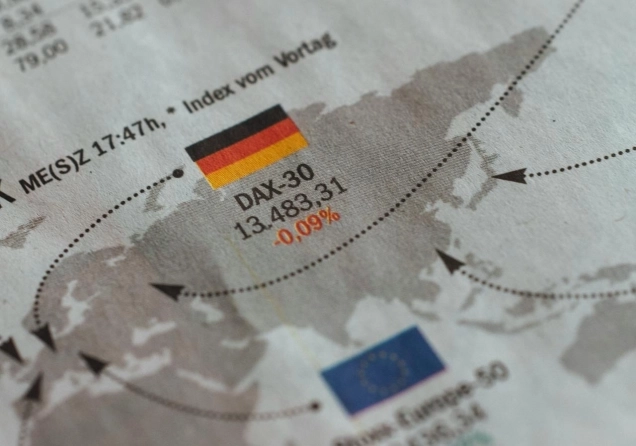
The DAX 40 is Germany’s flagship stock market index and one of the most actively traded indices in Europe. It tracks the performance of 40 of the largest and most liquid companies listed on the Frankfurt Stock Exchange. The index covers a wide range of sectors, including industrial manufacturing, automotive, chemicals, technology, healthcare, and financial services, with many constituents operating on a global scale.
The DAX 40 is weighted by market capitalisation, meaning larger companies have a greater influence on index movements. This structure makes the index more reflective of overall market value and investor capital flows. The DAX is also notable for its performance-based methodology, as constituent companies are selected not only by size but also by liquidity and trading volume.

The DAX 40 attracts substantial trading activity through futures, ETFs, options, and CFDs, particularly during the London trading session. Notably, according to Pepperstone, the Dax 40 had an average daily trading volume of $64 billion. It is highly sensitive to eurozone economic data, European Central Bank policy decisions, and global trade conditions. Because Germany is a major export-driven economy, movements in the DAX 40 often reflect broader trends in global manufacturing.
Nikkei 225 (Japan)
The Nikkei 225 is Japan’s primary stock market index and one of the most actively traded indices in Asia. It tracks 225 large, publicly listed companies on the Tokyo Stock Exchange, covering key sectors such as technology, automotive, industrial manufacturing, electronics, and financial services. The index includes globally influential corporations, making it a central benchmark for the Japanese equity market.

Like the Dow Jones Industrial Average, the Nikkei 225 is price-weighted rather than market-capitalisation-weighted. This means stocks with higher share prices have a greater impact on index movements. This unique structure contributes to the index’s distinct behaviour compared to many other global benchmarks.
The Nikkei 225 is mostly traded through futures, ETFs, options, and CFDs, particularly during the Tokyo trading session. It is highly sensitive to movements in the Japanese yen, Bank of Japan monetary policy decisions, and global trade developments. Its average daily trading volume in 2024 was recorded at $18 billion.
Why These Indices Dominate Global Trading
The indices highlighted above dominate global trading for several key reasons, primarily related to liquidity, economic significance, and accessibility. These include:
- Economic Indicators - These indices serve as the heartbeat of their respective economies. For example, the S&P 500 shows how the US economy is performing, while the DAX 40 gives insight into German and broader European industry. Any interest in their respective markets can lead to trading activity, as investors react to shifts in economic sentiment.
- High Liquidity - These indices are among the most heavily traded in the world. High trading volumes mean traders can buy or sell large positions quickly without causing big price changes, which is especially important for active traders.
- Wide Range of Trading Instruments - These indices are available through many products, including futures, options, ETFs, and CFDs. This makes them highly accessible and makes it easy for traders to implement different strategies ranging from short-term speculation to long-term portfolio hedging.
- Predictable Market Moves - While all markets fluctuate, these indices often move in response to scheduled events like central bank announcements, earnings seasons, or economic reports. This predictable pattern helps traders plan their strategies with more confidence.
- Global Trading Coverage - The global nature of these indices ensures that there is almost always an active session somewhere in the world. Traders can follow the Nikkei 225 during the Tokyo session, the DAX 40 during the London session, and the S&P 500 during the New York session, allowing nearly 24-hour participation.
Closing Remarks
The world's most traded indices are far more than simple lists of company stocks. They act as both benchmarks for economic performance and highly liquid trading instruments. Their movements are closely tied to macroeconomic data, central bank decisions, corporate earnings, and geopolitical developments. As such, they are essential tools for gauging market sentiment.
For traders and investors alike, these indices offer efficient exposure to entire markets without the need to select individual stocks. Their deep liquidity supports tight spreads and fast execution.
Additionally, the wide range of available instruments, including futures, ETFs, options, and CFDs, allows for diverse trading and hedging strategies. Understanding why these indices attract such high trading volumes helps traders better interpret market behaviour and refine their trading strategies.

Top-Tier Trusted Brokers
The table below contains links to 3rd party websites of our top partners from whom we receive compensation at no additional cost to you.