





Is XM Broker Halal or Haram According to Islam?

Whether trading with a particular broker is halal or haram is one of the first questions many Muslim traders ask. As online forex and CFD trading keeps growing, it matters more than ever to know whether a broker’s trading conditions and account types fit with Islamic financial principles.
XM is one of the best known forex and CFD brokers in the world, serving millions of clients in more than 190 countries. Alongside its standard accounts, it offers a swap-free Islamic account designed for traders who want to avoid interest on positions held overnight.
In this article, we look at whether trading on XM is halal or haram, what its Islamic account changes, and what questions remain around leverage and CFD trading. We also cover practical steps Muslim traders can take to keep their trading on XM closer to Islamic principles.
Your capital is at risk. Leveraged products may not be suitable for everyone.
Terms and conditions apply. Subject to regional availability.
The Islamic Principles That Matter for Trading
Islamic finance follows principles derived from the Quran and Hadith. Five of them decide most questions about online trading:
- Riba (interest): Paying or earning interest in any form is prohibited. For traders, this is the most direct issue.
- Gharar (excessive uncertainty): Contracts built on excessive uncertainty or ambiguity are not allowed.
- Maisir (gambling): Gains that depend purely on chance, with no link to value creation, are forbidden.
- Ownership: Traditional Islamic trade requires that you own what you sell.
- Ethical screening: Industries such as alcohol, pork, gambling and conventional banking are off limits.
Scholars disagree on how these principles apply to forex trading in general, a debate we cover in our article on whether forex trading is halal or haram. Here, we focus on XM.
Is XM’s Islamic Account Halal?
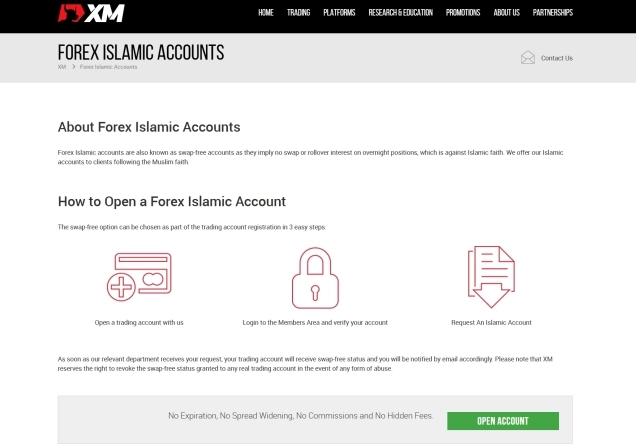
On a standard trading account, holding a position overnight triggers a swap, a charge or credit that works like interest. That is the clearest conflict with the ban on riba. XM’s Islamic account removes the swap, so positions can be held overnight without paying or earning it.
Some brokers replace the swap with an administration fee or wider spreads, which raises the question of whether the interest has simply been renamed. According to XM, its Islamic account carries no additional charges in place of the swap, which makes it a cleaner answer to the riba question. Swap-free status deals with riba only, though, not with leverage, CFDs or the instruments you trade.

Is Trading on XM Gambling?
Trading becomes maisir when outcomes depend on luck rather than knowledge. XM gives traders the tools to avoid that, including daily market analysis, live webinars, an economic calendar, a large education section and free demo accounts for practising a strategy before risking real money.
A trader who uses these resources, follows a plan and manages risk is running something closer to a business than a bet. A trader who opens positions on impulse, chases losses or relies on luck is not, whatever the account type. On XM, as with any broker, the difference comes down to how you trade.
Leverage at XM From a Sharia Perspective
XM lets traders choose their leverage when opening an account and offers high leverage for those who want it, but you are free to pick a much lower level. That flexibility matters, because leverage is one of the most debated points among scholars.
The interest concern is the easier one. On a standard account, the overnight swap is effectively the financing cost of a leveraged position, and the Islamic account removes it. The harder question is leverage itself. Some scholars argue that it encourages excessive risk and pushes trading towards maisir, while others treat it as a permissible tool when used conservatively. Choosing a low level of leverage keeps you on the cautious side of both views.
CFDs and the Question of Ownership
XM’s trading products are mainly CFDs on forex, indices, commodities, precious metals, energies, stocks and cryptocurrencies. With a CFD, you trade on the price of an asset without owning or receiving it, which conflicts with the principle that you should only sell what you own.
Stricter scholars consider CFDs a form of gharar and do not permit them. More lenient scholars accept them where the trade is executed immediately, no interest is involved and the trader understands the risks.

How to Trade on XM in Line With Islamic Principles
Opening a swap-free account is only the first step. How you set up the account and what you trade matter just as much. These steps will help Muslim traders keep their trading on XM closer to Islamic principles:
- Open the swap-free Islamic account: Choose the Islamic option rather than a standard account, and read XM’s Islamic account terms, including the conditions under which swap-free status can be reviewed or withdrawn. If you want to lower your costs, enter the TradingBeasts partner code REBATES30 during registration, as it cannot be added later.
- Choose a low leverage level: XM lets you set your leverage when you open the account. A low level limits how much a single trade can lose and keeps you on the cautious side of the scholarly debate.
- Practise on a demo account first: Build a strategy based on technical and fundamental analysis and test it with virtual money before you trade for real. This is what separates a planned business activity from a bet.
- Choose your instruments carefully: Major currency pairs, gold and silver are the most common choices among Muslim traders. If you trade index or stock CFDs, keep in mind that some of the underlying companies operate in banking, alcohol, gambling or other excluded industries.
- Manage your risk on every trade: Use stop loss orders to cap losses, avoid opening positions on impulse, and never risk money you cannot afford to lose.
- Ask a qualified scholar: Because opinions on leverage and CFDs differ, ask a trusted Islamic scholar or local religious authority which view applies to your own trading style.
The REBATES30 code gives a 30% rebate on every forex trade on Standard and Ultra Low accounts, credited automatically from the first trade. The rebate is a partial refund of the trading costs you pay, not interest, and it involves no swap component. You can find the full details in our XM partner code guide.
Final Verdict
XM’s Islamic account removes the overnight swap without replacing it with an administration fee, which makes XM one of the stronger choices for Muslim traders on the riba question.
Beyond riba, whether trading on XM is halal depends on how you trade and which scholarly view you follow. Keeping leverage low, screening what you trade and following a clear plan all move your trading closer to what more lenient scholars accept, while stricter scholars may still object to leveraged CFD trading itself. The final decision rests with each trader, ideally with the guidance of a trusted scholar.
Your capital is at risk. Leveraged products may not be suitable for everyone.
Terms and conditions apply. Subject to regional availability.


Top-Tier Trusted Brokers
The table below contains links to 3rd party websites of our top partners from whom we receive compensation at no additional cost to you.